


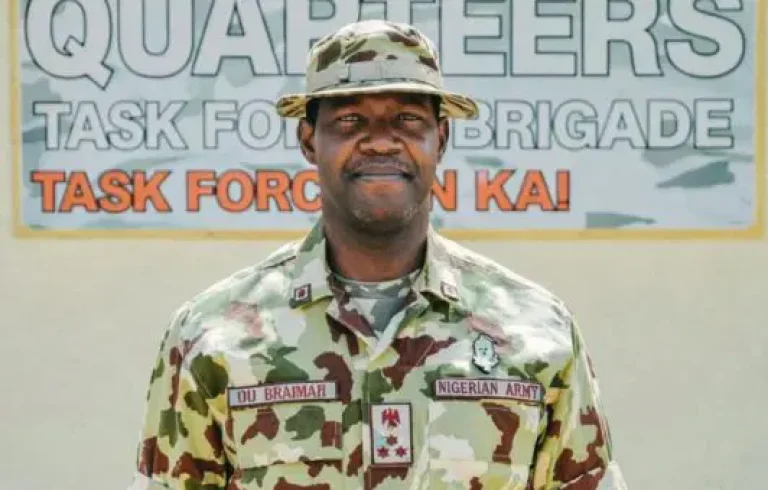
Brigadier General Oseni Braimah, commander of the 29th Task Force Brigade, was killed in a coordinated insurgent attack highlighting Nigeria’s worsening security situation.
The attack occurred around 12.30am on Thursday when suspected Boko Haram and Islamic State West Africa Province fighters launched simultaneous assaults on military positions in Benisheikh, Kaga Local Government Area along the Maiduguri-Damaturu highway.
Survivors described the incident as one of the most intense recent engagements, noting its severity in the North-East theatre of operations.
Conflicting reports initially suggested he died due to a malfunctioning Mine-Resistant Ambush Protected vehicle, though military sources later disputed the claim.
Braimah was known for his towering presence and calm demeanour, widely respected as a disciplined officer who served Nigeria with distinction.
He hailed from Edo State and held a Bachelor of Arts in History from the Nigerian Defence Academy.
He also earned a Diploma in Strategic Leadership and Management from the Chartered Management Institute.
His postgraduate studies included a Master of Arts in Defence Studies from King’s College London and another in International Relations from Benue State University.
He further obtained advanced qualifications in National Security Management and War Studies from the National Defense University Islamabad.
Between September 2024 and March 2025, he served as Chief of Staff at 6 Division Headquarters in Port Harcourt, Rivers State.
He coordinated operations, supervised training, and ensured readiness through strategic planning and contingency frameworks.
From 2015 to 2019, he served as Chief Instructor at the Armed Forces Command and Staff College Jaji, mentoring officers and overseeing training programmes.
He previously commanded the Infantry Presidential Guards Battalion in Abuja between 2014 and 2015, handling presidential security and ceremonial duties.
In 2014, he oversaw logistics and administration for the Guards Brigade, coordinating ceremonial events and advising on personnel matters.
He also served as a United Nations military observer between 2011 and 2012, contributing to peacekeeping and intelligence support operations.
His legacy is defined by service, professionalism, and sacrifice, and he is remembered as a committed leader who inspired discipline and courage.
He remains regarded among colleagues as an exemplary officer whose leadership style combined operational excellence, mentorship, integrity, and unwavering dedication to national service until his final deployment.

